Tech
November 28, 2026
Cygnus XL cargo ship set for Sunday launch to the space station with 11,000 pounds aboard
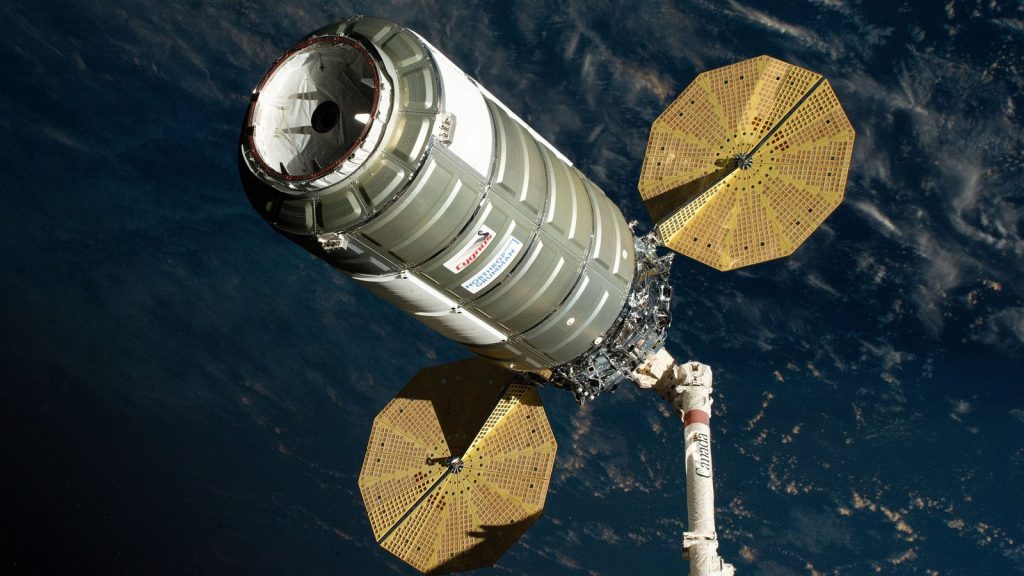
A Cygnus XL cargo spacecraft in the grip of the station’s Canadarm2 robotic arm on an earlier mission, April 13, 2026. Photo: NASA Johnson Space Center / Wikimedia Commons, public domain
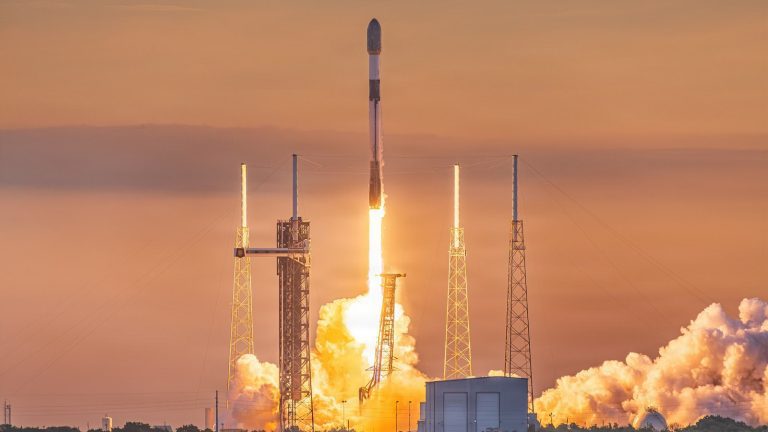
A Northrop Grumman Cygnus XL cargo ship carrying about 11,000 pounds of supplies and research is set to lift off for the International Space Station on Sunday, Nov. 29, at 10:47 a.m. EST. It will fly on a SpaceX Falcon 9 rocket from Space Launch Complex 40 at Cape Canaveral Space Force Station in Florida.
NASA calls the flight Northrop Grumman Commercial Resupply Services 25, or CRS-25. In a space station blog update posted Friday afternoon, the agency said the station’s Mission Management Team had polled “go” to keep launch preparations moving after reviewing the weather forecast and the remaining work. SpaceX planned to roll the Falcon 9 out to the pad on Saturday.
Weather is the main question
The early forecast gives a 60% chance of favorable conditions on Sunday. NASA said the thick cloud layer rule is the main concern. That launch rule keeps rockets from flying through deep cloud decks that can build up electrical charge. If Sunday does not work, the next opportunity is Monday, Nov. 30, at 10:24 a.m. EST. NASA said teams would keep watching the forecast through the weekend.
A bigger Cygnus on its third trip
According to NASA’s mission overview, this is the third flight of the Cygnus XL. That is a larger version of Northrop Grumman’s solar-powered cargo craft, built to carry more. The spacecraft for this flight is named for Apollo 13 commander James “Jim” A. Lovell Jr. Lovell flew four missions: Gemini VII, Gemini XII, Apollo 8 and Apollo 13.
Cygnus does not dock on its own. When it reaches the station, NASA astronaut Jessica Watkins will be at the controls of the Canadarm2 robotic arm to capture it, while NASA astronaut Luke Delaney monitors the approach. Ground controllers will then use the arm to install the spacecraft on the Earth-facing port of the station’s Unity module so the crew can unload it.
What is in the cargo hold
Alongside food, equipment and other crew supplies, NASA lists several experiments on board:
- Cardinal Muscle 2.0. Researchers will grow engineered human muscle tissue in a bioreactor and test whether drugs already approved by the Food and Drug Administration for other conditions can prevent or slow muscle loss. Astronauts lose muscle fast in microgravity, and NASA says the pattern shares many features with age-related muscle decline on Earth.
- DNA Nano B. A University of Connecticut project will use microgravity to make tiny DNA-inspired particles meant to carry medicine into dense tissue such as cartilage and solid tumors. The aim is more uniform particles, with possible uses in cancer and osteoarthritis treatment.
- Encapsulate-1. Miniature copies of patients’ tumors will be grown in a biochip to study how cancer cells move and invade nearby tissue. The researchers hope to build a diagnostic tool that could predict whether a cancer is likely to spread.
- ARES. The Active Radiation Environment Sensor is a small device that tracks radiation in real time inside crew living areas. NASA says it is meant to support Artemis and other lunar missions.
- Ohalo III. A mostly automated plant growth facility from Utah State University will test water delivery and air exchange for growing food crops on long missions, including future trips to Mars.
The overview also lists a technology demonstration called JOINS, which is set to try autonomous robotic welding inside the station’s Bishop Airlock.
Why these runs matter
Cargo flights like this one keep the station’s experiments supplied. Much of the work on this manifest is aimed at problems on the ground, such as muscle loss with age and predicting cancer spread, as well as at keeping crews healthy and fed farther from Earth. Commercial space has been busy lately: this month the FCC approved a SpaceX plan for orbital data-center satellites, and Google booked a Blue Origin New Glenn launch for its Project Suncatcher.
NASA has scheduled live coverage of the launch. If the clouds cooperate, the next update should come from the pad on Sunday morning. More space and technology coverage is in our Tech section.
Add Verity News as a preferred source on Google (opens in a new tab)