
Health
November 26, 2026
FDA approves Rinvoq as the first pill for nonsegmental vitiligo, for patients 12 and older
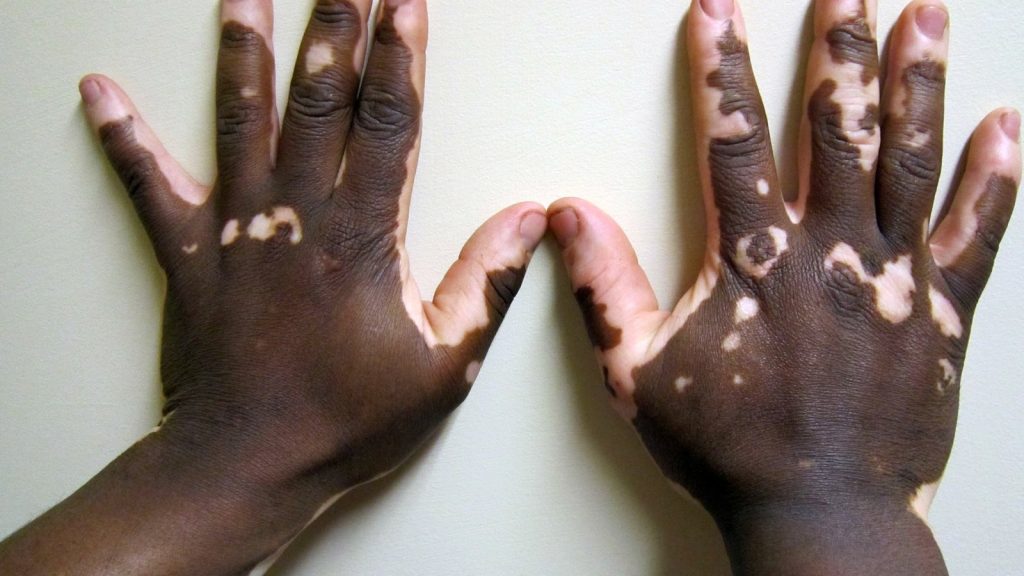
Nonsegmental vitiligo typically appears as symmetrical depigmented patches, such as on both hands. Photo: James Heilman, MD / Wikimedia Commons, CC BY-SA 3.0
The Food and Drug Administration has approved Rinvoq, AbbVie’s once-a-day JAK inhibitor pill, for nonsegmental vitiligo in adults and children 12 and older. It is the first systemic drug, meaning one that works through the whole body rather than on a patch of skin, approved in the U.S. for the condition.
The FDA approval letter covers the 15-milligram extended-release tablet and the oral solution, and AbbVie announced the decision Nov. 23. Vitiligo affects nearly 3 million U.S. adults, according to the company.
Nonsegmental vitiligo is the most common form. The immune system attacks melanocytes, the cells that make pigment, leaving pale patches that usually appear on both sides of the body, as on the hands in the photo with this story. Until now the only targeted prescription option was Incyte’s Opzelura cream, which Fierce Pharma noted is labeled for use on no more than 10% of the body at a time.
What the trials showed
Approval rests on two matching Phase 3 studies, Viti-Up-1 and Viti-Up-2, that compared Rinvoq with a placebo for 48 weeks in patients 12 and older. The trials had two main goals: getting back at least 75% of lost color on the face, and at least 50% across the whole body.
At week 48, 25% and 23% of patients on Rinvoq reached the facial goal in the two studies, compared with 6% and 7% on placebo. For the whole-body goal the numbers were 19% and 21%, against 6% in both placebo groups. A stricter facial target, 90% repigmentation, was met by 16% and 12% of Rinvoq patients and 2% and 3% on placebo.
Put plainly, most people on the drug did not reach either goal within the first year. Results kept improving with longer use: among patients who stayed on Rinvoq in the open-label extension, 55% and 47% hit the facial goal by week 76, and 43% and 40% hit the body goal. Those later figures have no placebo group to compare against, and AbbVie describes them as descriptive.
Seemal R. Desai, president of the Global Vitiligo Foundation and a trial investigator, said in the company’s release that “repigmentation takes time” and that the week 76 results were “especially encouraging.”
The safety warnings come with it
Rinvoq is not new. It already had nine other U.S. approvals, including rheumatoid arthritis, eczema, ulcerative colitis and Crohn’s disease, and vitiligo is its 10th. That history means its risks are well documented. Like other JAK inhibitors it carries a boxed warning for serious infections, death, cancers including lymphoma, major heart events and blood clots, with the highest heart and death risk in people 50 and older who have at least one cardiovascular risk factor.
The same FDA letter also approved new label language on cerebral venous thrombosis, a clot in the veins that drain the brain, after the agency told AbbVie in October that the risk needed to be added. Patients are tested for tuberculosis before starting. AbbVie said the safety profile in the vitiligo studies was generally consistent with the drug’s other uses.
The FDA waived pediatric studies for children under 6, citing how rare the condition is at that age, and deferred studies in children 6 to 11. For now the approval stops at 12.
What patients can do next
Rinvoq is a prescription drug, so the first step is a dermatologist visit to confirm the type of vitiligo and talk through whether a pill with a boxed warning makes sense compared with light therapy or creams. Because the drug is already on the market for other conditions, doctors can prescribe it for vitiligo now. Coverage for the new use will depend on each insurer adding it to its policies.
AbbVie’s trials continue in a 112-week extension, and the company is also testing Rinvoq in alopecia areata and lupus. For other recent approvals, see our coverage of Livsayis for myasthenia gravis and Wilserdly for advanced breast cancer, or browse the Health section.
Add Verity News as a preferred source on Google (opens in a new tab)