Tech
November 20, 2026
Google books Blue Origin’s New Glenn for its first heavy-lift Project Suncatcher launch in 2029
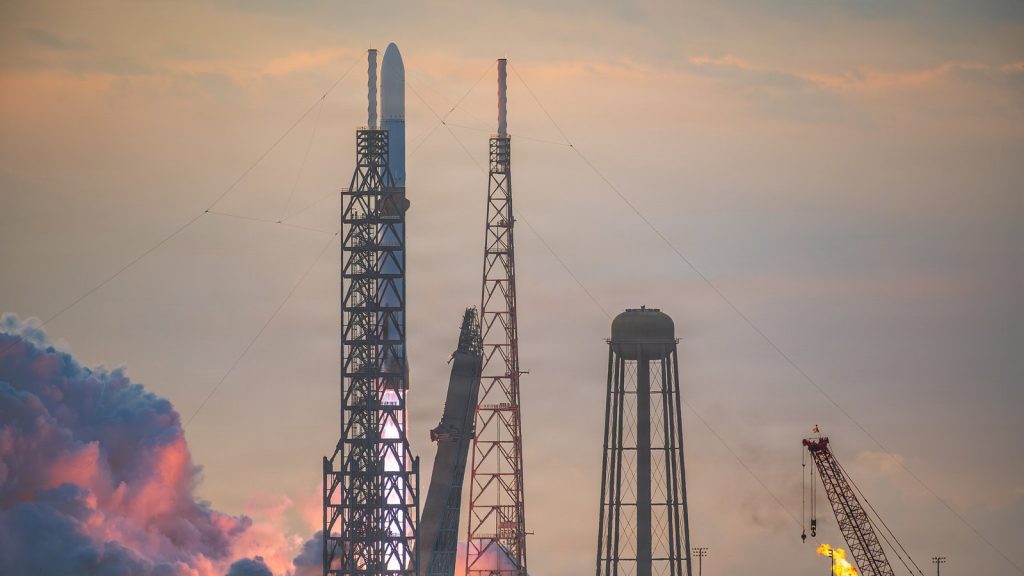
New Glenn lifts off from Space Launch Complex 36 at Cape Canaveral Space Force Station on its April 19, 2026, BlueBird 7 mission. Photo: U.S. Space Force photo by Gwendolyn Kurzen, public domain, via Wikimedia Commons.
Google has hired Blue Origin to fly the first big batch of its experimental space-based AI computers. The companies said Thursday that a New Glenn rocket will carry Project Suncatcher satellites, each holding roughly a data center rack’s worth of computing, into sun-synchronous orbit in the first quarter of 2029.
The deal, announced in a Google post and a matching Blue Origin release on Nov. 19, is the first dedicated heavy-lift launch Google has booked for the project. Neither company said how many satellites will ride on the rocket or what the contract is worth.
It is a step from research toward hardware at a time when the cost of power for AI data centers on the ground has become one of the main limits on how fast the industry can grow.
What Google is trying to build
Google first described Project Suncatcher a year ago, on Nov. 4, 2025, in a Google Research post and preprint paper. The idea is to put Google’s Tensor Processing Units, the custom chips it uses to train and run AI models, on solar-powered satellites that fly in tight formation and pass data to one another over laser links.
The appeal is power. In the right orbit, Google wrote, a solar panel can be up to eight times more productive than on Earth and can run almost continuously, which cuts the need for heavy batteries. The company’s design calls for a dawn-to-dusk sun-synchronous orbit, the kind of path that keeps a satellite near the line between day and night so its panels stay in sunlight.
That 2025 paper laid out the hard parts. To match the links inside a ground data center, satellites would need connections carrying tens of terabits per second, which Google said means flying them within a kilometer or less of each other. Its illustrative cluster had 81 satellites at about 650 kilometers altitude, with neighbors roughly 100 to 200 meters apart. A bench test had already pushed 1.6 terabits per second through a single pair of transceivers.
Google also put its Trillium TPU in a 67 MeV proton beam to see how it handles radiation. The memory showed irregularities only after a dose nearly three times what a shielded chip would absorb over a five-year mission, and no chip failed outright at the highest dose tested, according to the research post.
From a prototype to a rack in orbit
The 2025 plan called for a learning mission with Planet, the satellite imaging company, to put two prototype satellites up by early 2027. That work has moved faster. Google flew its first TPU-equipped satellite on a SpaceX rideshare in October, booted the chips in orbit and used an onboard Gemma model to send a haiku back to Earth, The Verge reported.
The 2029 mission is a different scale. A rideshare slot puts one small payload on a rocket shared with many customers. A dedicated New Glenn flight gives Google the whole rocket, and Blue Origin is selling exactly that.
“Its heavy-lift capacity and large payload volume give customers the flexibility to bring new capabilities to orbit,” Jordan Charles, Blue Origin’s senior vice president for New Glenn, said in the company’s statement.
Travis Beals, the Google senior director who leads the project, called the launch “a crucial milestone on our roadmap as we expand the boundaries of what’s possible for the future of compute.”
New Glenn is still early in its flight history. The 98-meter rocket first flew in January 2025 and carried AST SpaceMobile’s BlueBird 7 satellite from Space Launch Complex 36 at Cape Canaveral in April, according to U.S. Space Force mission photos of that launch.
The money question
Google has been open that Suncatcher only works if launch gets much cheaper. Its research team projected that prices could fall below $200 per kilogram by the mid-2030s if the industry keeps its current learning curve. At that point, Google estimated, launching and running a space data center could cost about the same per kilowatt-year as the energy bill for a comparable data center on the ground.
The paper also listed problems still unsolved: getting rid of heat in a vacuum, moving huge amounts of data down to Earth, and keeping hardware reliable with no technician on hand. A 2029 flight of rack-sized satellites would be the first real test of several of those at once.
Google is not alone in looking up. Other companies building AI infrastructure have floated orbital data centers, and launch providers are courting them as a new market for heavy rockets. Our Tech section has followed the satellite business this fall, including the FCC’s approval of Amazon Leo’s $11.5 billion Globalstar deal and the nationwide Emergency Alert System test earlier this week.
Next up for Suncatcher is more data from the October prototype and, in the first quarter of 2029, the New Glenn launch itself. Google has not said when it will name the satellite builder for the larger spacecraft or how many it plans to fly.
Add Verity News as a preferred source on Google (opens in a new tab)