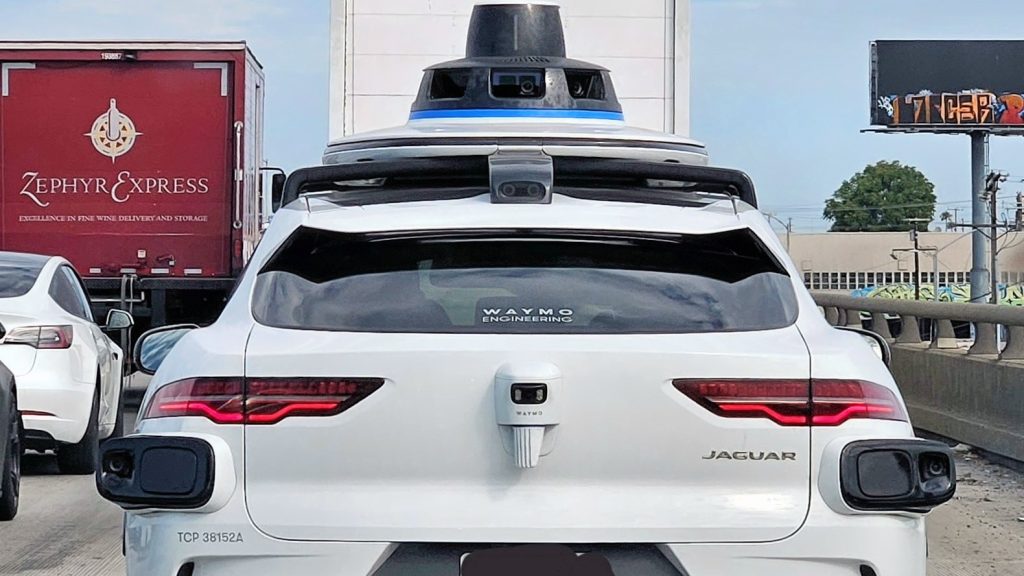
A Waymo driverless car on a freeway. Photo: Eric Polk, CC BY-SA 4.0, via Wikimedia Commons.
Waymo’s driverless cars are off California freeways, and the state says they stay off until the company shows regulators it has fixed the problem that put them there: robotaxis rolling into active construction zones.
The California Department of Motor Vehicles restricted Waymo on Nov. 11, barring it from operating or testing driverless vehicles on any California freeway. Department spokesperson Jonathan Groveman said in a statement, as reported by The Associated Press, that the department “determined that Waymo’s driverless freeway operations pose an imminent hazard to public safety due to recurring incursions by its vehicles into active construction zones where construction workers, vehicles and equipment are present.”
Waymo responded by pausing paid freeway rides everywhere it offered them, not just in California. A company spokesperson told the AP it had “temporarily restricted commercial freeway rides in all markets where we operate that service,” while continuing freeway testing with trained specialists behind the wheel. Freeway trips had been available to riders in the San Francisco Bay Area, Los Angeles, Phoenix, Miami and Austin.
Two incidents in two days
According to the DMV, the first incident came on Nov. 5, when three Waymo vehicles drove into a freeway construction zone. The next day, on a San Francisco highway, a Waymo tried to get around California Highway Patrol cars running a traffic break, a maneuver captured on video that spread widely online. Groveman said similar incidents had happened before, on May 18.
Waymo has said the construction-zone encounters on U.S. 101 caused no injuries or collisions. That matters less to the DMV than the pattern. The state’s order is not a fine or a permit revocation; it is a restriction that stays in place until, in Groveman’s words, “Waymo demonstrates to the Department that it has taken effective corrective actions to address the deficiencies that precipitated the restrictions.”
Construction zones have been a known weak spot. In June, Waymo recalled about 3,900 robotaxis after some of them drove into freeway work zones, the AP reported at the time. The November incidents suggest that software update did not close the gap.
The rules the DMV is now using
California rewrote its autonomous vehicle rulebook this spring. The regulations the DMV adopted on April 28 let police issue a “Notice of AV Noncompliance” to a manufacturer when a driverless car commits a moving violation, require companies to answer first responders within 30 seconds, and let local emergency officials draw temporary “do not enter” zones that AVs must leave and stay out of.
The same package spelled out the consequence for breaking those orders: permit restrictions or suspension, “depending on the circumstances of the incident.” The freeway ban is that tool in use. It also shows how state regulators, rather than federal ones, set the day-to-day terms for where robotaxis can go. The federal government handles recalls and vehicle safety standards; California decides which roads a permit covers.
“These updates support the growth of the AV industry by enhancing public safety and transparency while adding additional accountability for AV manufacturers,” DMV Director Steve Gordon said when the rules were adopted.
What riders will notice
For most Waymo customers, not much. The company’s core service runs on city streets in a growing list of metros, and those rides continue. The change hits longer trips, such as airport runs and cross-town rides where a freeway segment saves real time. Those now route over surface streets or are unavailable.
For the industry, the episode is a test of how quickly a company can satisfy a regulator after a targeted restriction. Freeway driving is a selling point for robotaxi operators trying to compete with ride-hailing on longer, more profitable trips, and Waymo has been one of the most closely watched companies in tech as it expands city by city. Space and AI bets like Google’s Project Suncatcher launch with Blue Origin grab headlines, but the robotaxi business is where Alphabet’s autonomy work meets daily traffic.
Neither the DMV nor Waymo has given a date for lifting the restriction. The next step belongs to Waymo: it has to submit corrective actions that convince the department its cars can recognize and stay out of active work zones. Until then, the freeway lanes stay closed to its driverless fleet in its home state.
Add Verity News as a preferred source on Google (opens in a new tab)