Uncategorized
November 24, 2026
The Democratization Of Industrial Power: How Everlast Welders And Generators Changed Modern Fabrication
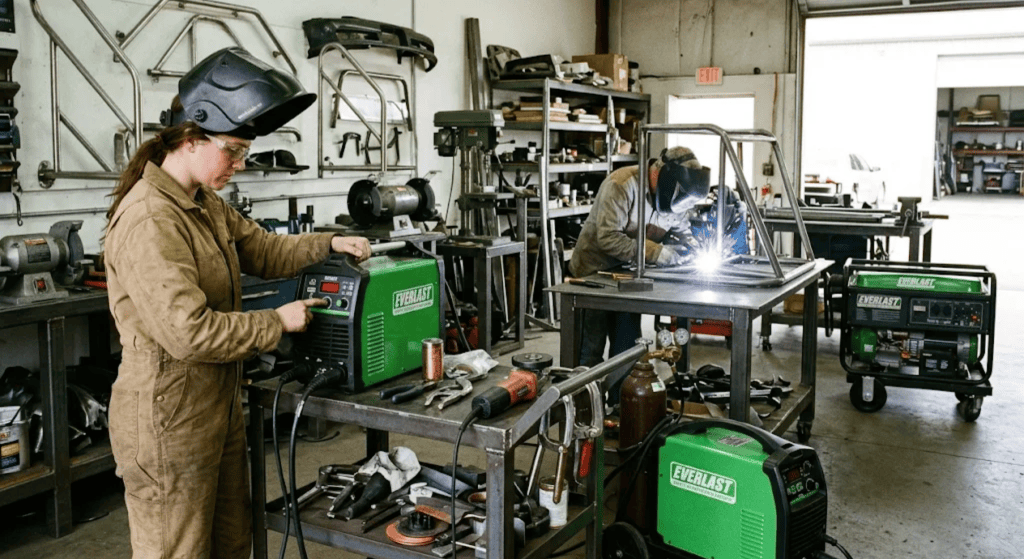
For decades, professional metalworking and portable industrial power belonged almost exclusively to large manufacturing plants and heavily capitalized contractors. Achieving clean AC/DC TIG welds, high-amperage plasma cuts, or reliable job-site power meant investing in massive, copper-wound transformer machines that weighed hundreds of pounds and required dedicated three-phase electrical infrastructure.
Over the last twenty years, however, advances in solid-state electronics have reshaped the fabrication landscape. Independent workshops, mobile repair technicians, agricultural operators, and skilled hobbyists now have access to digital capabilities that once required industrial budgets. Looking closely at the evolution of Everlast welders and generators which began in California in 2004 with a focus on direct-to-user inverter equipment offers a clear window into how modern power electronics democratized high-precision metal fabrication.
From Heavy Transformers to High-Frequency IGBT Inverters
The primary technological catalyst behind modern welding and cutting equipment is the Insulated-Gate Bipolar Transistor (IGBT) inverter. Traditional transformer welders step down incoming line voltage using heavy magnetic coils, resulting in bulky footprints, high idle energy draw, and limited waveform adjustment.
By contrast, IGBT inverter architectures convert standard AC utility power into high-frequency DC, allowing microprocessors to shape the electrical arc in real time.
| Operational Metric | Legacy Transformer Machines | Modern IGBT Inverter Equipment |
|---|---|---|
| Weight & Mobility | Heavy, stationary shop-bound units | Lightweight, compact, field-portable designs |
| Input Power Flexibility | Typically fixed single-voltage wiring | Frequently dual-voltage (120V/240V) capable |
| Arc & Waveform Control | Basic mechanical tap or dial settings | Digital pulse, AC frequency, and balance tuning |
| Energy Efficiency | Higher power consumption under load | Improved electrical efficiency and duty cycles |
This shift did more than shrink machine dimensions; it gave fabricators granular control over heat input, puddle fluidity, and arc stability across thin-gauge aluminum, stainless steel, and heavy structural plate.
Multi-Process Consolidation on the Shop Floor
Another major shift in modern workshop strategy is the rise of multi-process platforms. Historically, a fabrication shop needed separate dedicated power sources for MIG wire feeding, TIG precision work, Stick structural welding, and air plasma cutting.
Modern inverter engineering allows manufacturers to integrate multiple processes such as MIG/TIG/Stick combined with pilot-arc plasma cutting into a single enclosure. For independent businesses and field mechanics, multi-process consolidation delivers measurable operational advantages:
- Lower Capital Barriers: Acquiring one multi-process machine reduces upfront equipment costs while expanding the range of materials and thicknesses a shop can accept.
- Space Optimization: Consolidating four machines into one frees up critical square footage for layout tables, material storage, and safety clearances.
- Rapid Workflow Transitions: Operators can switch from cutting mild steel plate with a plasma torch to welding aluminum brackets with pulse TIG without relocating heavy equipment.
By focusing on direct-to-consumer distribution and accessible pricing, Everlast welders and generators helped push advanced features like high-frequency starts, pulse modulation, and CNC-ready plasma interfaces into everyday workshops.
Clean Power and Field Independence
While shop-based fabricators rely on stable utility grids, agricultural technicians, pipeline crews, and emergency responders often operate miles away from municipal power lines. Pairing inverter welding systems with reliable portable generators bridges that gap provided the power source delivers clean, stable voltage.
Sensitive microprocessor-controlled welders require consistent electrical output with low total harmonic distortion (THD) to protect internal circuit boards and maintain smooth arc starts. Understanding the relationship between generator output, surge capacity, and welder duty cycle is essential for anyone building a mobile service rig. Properly matched power generation ensures field operators achieve the same weld integrity on a remote job site as they do inside a climate-controlled shop.
Conclusion
The evolution of metalworking equipment demonstrates how thoughtful engineering can lower barriers to craftsmanship and entrepreneurship. Through the adoption of IGBT inverter technology, multi-process versatility, and reliable portable power solutions, Everlast welders and generators reflect a broader industry shift toward compact, capable, and cost-effective tools. Whether outfitting a mobile repair truck or expanding a custom fabrication shop, understanding how modern power electronics work empowers operators to invest wisely and build with confidence.
Frequently Asked Questions (FAQs)
What makes IGBT inverter welders different from older transformer machines?
IGBT inverter welders use high-speed electronic switching to regulate electrical current instead of relying on massive copper-wound transformers. This makes them significantly lighter, more energy-efficient, and capable of digital arc adjustments like pulse control and adjustable AC frequency.
Can inverter welders safely run off a portable generator?
Yes, provided the generator supplies clean power with low total harmonic distortion (THD) typically under 5% to 6% and offers sufficient continuous wattage to handle the welder’s maximum amperage draw without voltage drops.
Why do multi-process welders appeal to independent shops and mobile mechanics?
Multi-process machines combine capabilities like MIG, TIG, Stick welding, and plasma cutting into one portable unit. This saves shop floor space, reduces equipment costs, and allows technicians to handle diverse metals and repair scenarios without carrying multiple machines.
What is dual-voltage capability, and why is it useful?
Dual-voltage equipment can operate on both standard 120V household outlets and 240V shop or generator circuits. This allows operators to perform light-duty repairs anywhere standard power is available while accessing full amperage capacity on 240V lines.
Add Verity News as a preferred source on Google (opens in a new tab)