People & Profiles
August 25, 2026
Andrew Carnegie: from bobbin boy to the man who paid for 2,500 libraries
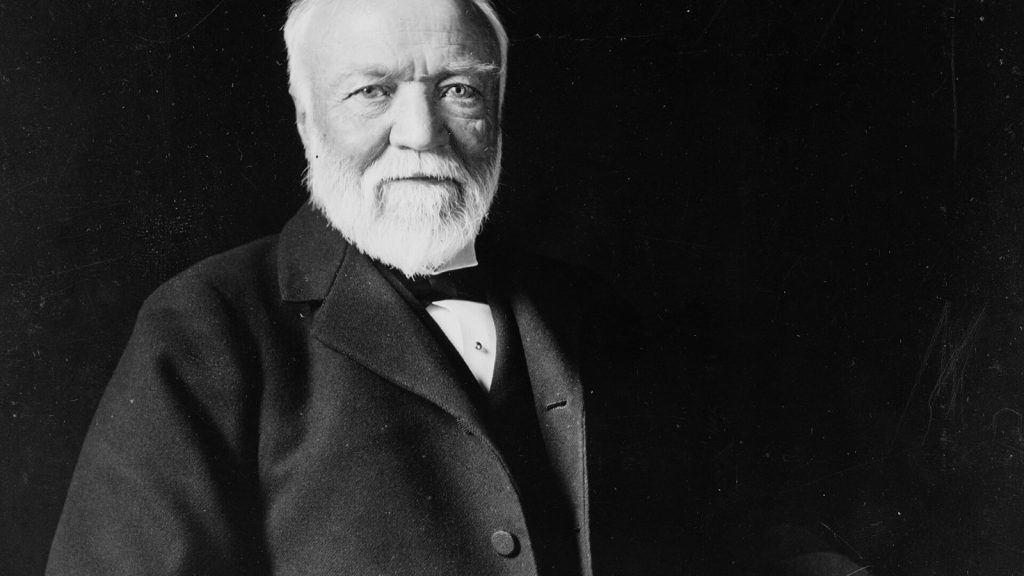
Photo: Theodore C. Marceau, public domain, via Wikimedia Commons.
Andrew Carnegie was born in Dunfermline, Scotland, in 1835. His family came to the Pittsburgh area in 1848, and at 13 he went to work as a bobbin boy in a cotton mill for $1.20 a week.
He moved on to a telegraph office and then to the Pennsylvania Railroad, where he became a superintendent. He invested his savings in railroad sleeping cars, oil and iron.
Steel
In the 1870s Carnegie turned to steel. His Edgar Thomson Works near Pittsburgh used the Bessemer process, and he kept cutting costs. Carnegie Steel became the biggest steel producer in the country.
The company’s record is not clean. In 1892 a strike at the Homestead works ended in a gun battle between workers and Pinkerton guards that left several people dead.
In 1901 Carnegie sold the company to J.P. Morgan for about $480 million. It became the core of U.S. Steel.
Giving it away
Carnegie had written that “the man who dies thus rich dies disgraced.” He paid for more than 2,500 public libraries around the world, about 1,700 of them in the United States. He also built Carnegie Hall and founded what became Carnegie Mellon University and the Carnegie Endowment for International Peace.
He died in 1919 in Lenox, Massachusetts.