
Lifestyle
October 30, 2026
Clocks fall back Sunday. Congress still can’t agree on whether they should
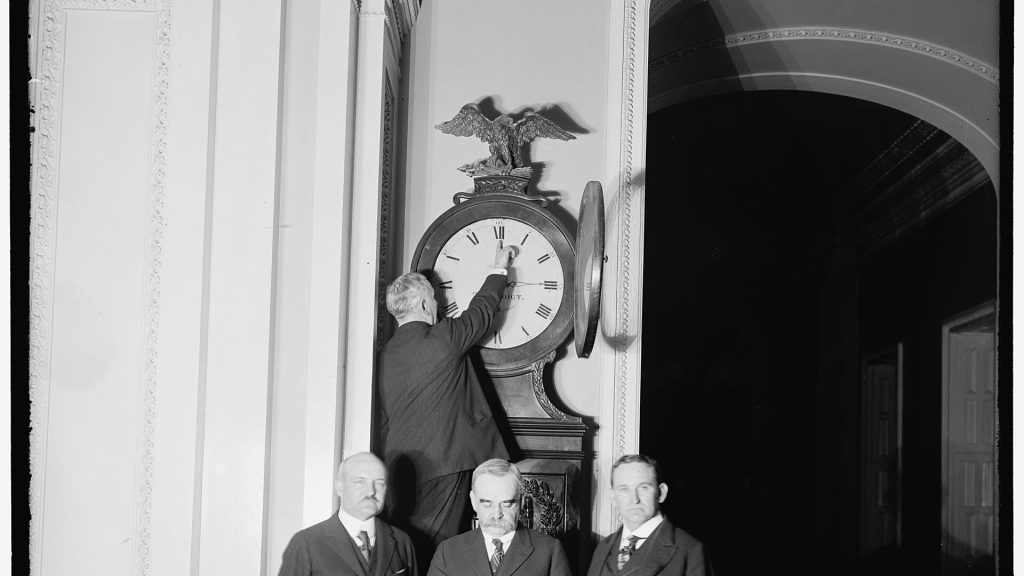
Photo: Harris & Ewing Collection, public domain, via Wikimedia Commons.
Most Americans get an extra hour of sleep this weekend. Daylight saving time ends at 2 a.m. local time on Sunday, Nov. 1, when clocks fall back to 1 a.m. Phones and computers will update on their own. Oven clocks, car dashboards and the wall clock in the hallway will not.
The change also restarts a debate Congress has been having for years, and that got further this year than it ever has.
Who changes and who doesn’t
The switch applies to nearly the whole country. Hawaii and most of Arizona stay on standard time all year and don’t change their clocks. The Navajo Nation in northeastern Arizona does observe daylight saving time. U.S. territories such as Puerto Rico, Guam and the U.S. Virgin Islands also stay put.
For everyone else, the practical result is brighter mornings and much earlier sunsets. In many cities, the sun will set before 5:30 p.m. the week after the change, and earlier still by the December solstice. Daylight saving time returns on Sunday, March 14, 2027.
The House voted. The Senate hasn’t.
On July 14, the House passed the Sunshine Protection Act by a vote of 308 to 117, Reuters reported. The bill would make daylight saving time permanent nationwide, ending the twice-a-year clock change. The version that passed lets states opt out and stay on standard time instead.
That was a first for the House. In 2022 the Senate passed a version of the bill by unanimous consent, but the House never took it up. This time the roles are reversed. The House bill went to the Senate Commerce Committee and has stayed there. Senate Majority Leader John Thune has said he sees no clear path for it, The Hill reported.
The White House has backed the idea of permanent daylight saving time. Without Senate action, though, the bill dies when the current Congress ends in January, and supporters would have to start over.
Later sunrises are the sticking point
The public is split on what to do, even though most people say they dislike changing the clocks. A 2025 AP-NORC poll found that just over half of U.S. adults would prefer permanent daylight saving time, while just under half would prefer permanent standard time.
The trade-off is easier to see with real numbers. In Charlotte, North Carolina, WBTV calculated that under permanent daylight saving time the latest winter sunrise would come at 8:32 a.m., with the earliest sunset at 6:10 p.m. On standard time, those times are 7:32 a.m. and 5:10 p.m. Cities on the western edges of their time zones would see even later sunrises.
That is the main argument opponents make. Permanent daylight saving time would mean children waiting for school buses and adults commuting in the dark for weeks in winter. The United States tried year-round daylight saving time once before, in 1974 during the energy crisis. It proved unpopular once winter mornings arrived, and Congress reversed it within the year.
Sleep researchers mostly favor the other option. The American Academy of Sleep Medicine has called for permanent standard time, arguing it lines up better with the body’s natural clock, which relies on morning light.
Getting through the switch
The fall change is usually easier on the body than the spring one, because it adds an hour instead of taking one away. Still, it can throw off sleep and appetite for a few days, especially for young children, older adults and pets that expect breakfast at a certain time.
Some simple steps help. Shift bedtimes and meals by 15 minutes or so over a couple of days if your household is sensitive to schedule changes. Get outside in the morning light on Sunday and Monday. And be extra careful on the road during the evening commute next week, when the drive home suddenly happens after dark.
Many local fire departments also use the time change as a reminder to test smoke and carbon monoxide alarms, which is an easy habit to tie to the twice-a-year switch, at least for now.
The clock change itself was first adopted nationally in 1918, when the Senate’s Ohio Clock was among those turned forward that spring. More than a century later, Congress is still arguing about whether to keep doing it.