
Tech
October 29, 2026
FCC clears Amazon Leo’s $11.5 billion Globalstar deal, opening a path to satellite-to-phone service
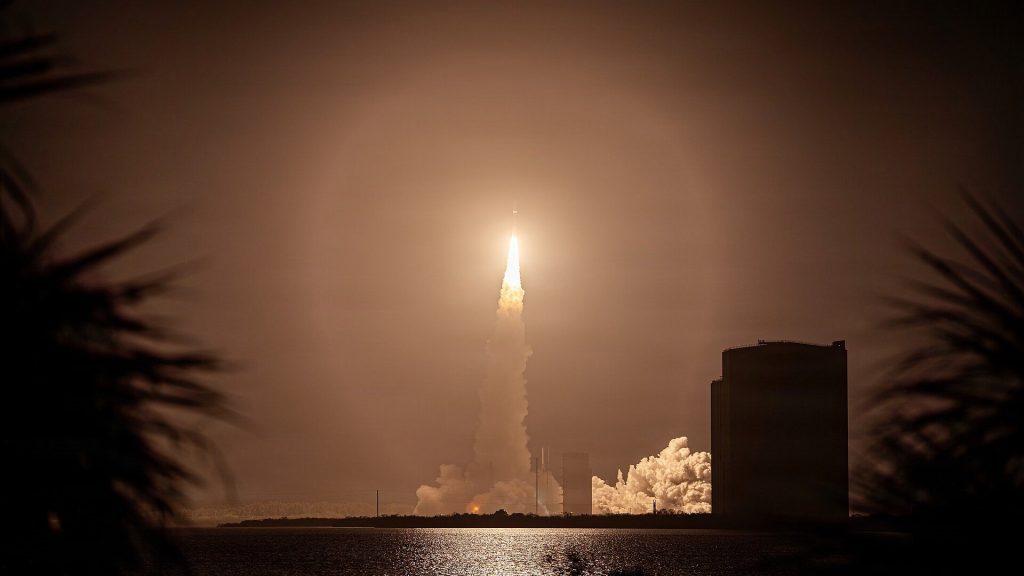
Photo: U.S. Space Force photo by Robert Mason, public domain, via Wikimedia Commons.
Amazon’s satellite internet business cleared its biggest regulatory hurdle this week. On Oct. 27 the Federal Communications Commission approved Amazon Leo’s purchase of Globalstar, a deal valued at roughly $11.5 billion that hands Amazon a working fleet of satellites, a block of mobile-satellite spectrum and a faster route into the business of connecting ordinary phones directly to space.
The approval came from the FCC’s Space Bureau, which signed off on transferring about 25 megahertz of Globalstar’s mobile-satellite service spectrum to Amazon. With that, the agency said it had concluded its review of the transaction. In its order, the FCC found the deal was likely to improve data coverage in unserved and underserved areas, strengthen emergency communications and support industrial and enterprise data services, and that no material harm to the public interest was likely. The agency also noted that the two companies don’t really compete head to head: Globalstar sells mobile-satellite connectivity and wholesale capacity for messaging, tracking and Internet of Things devices, while Amazon Leo has been built for high-speed fixed broadband.
Amazon Leo is the name the company now uses for what began as Project Kuiper. Reuters reported that it has launched several hundred satellites since April 2025 and aims to have thousands in low Earth orbit by 2029. According to the FCC, Amazon has committed more than $10 billion to the network and is preparing to start commercial service by the end of 2026. Globalstar adds about two dozen satellites already in orbit.
The bigger prize is what engineers call direct-to-device, or D2D, service: a satellite talking to a standard smartphone without a dish or special antenna. It is the same market SpaceX is pursuing with T-Mobile through Starlink, and it matters most in the places cell towers don’t reach, from rural highways to national parks to disaster zones where ground networks have gone down. Globalstar already has a foothold. Its network carries the emergency satellite messaging feature built into recent iPhones, under a long-running agreement with Apple.
Amazon signaled its plans in April, when it filed with the FCC to launch a separate Amazon Leo direct-to-device constellation of up to 5,105 satellites using the L-band and S-band spectrum it is acquiring from Globalstar. The FCC’s order makes the connection plain. “The transaction would enable a well-financed operator to provide enhanced D2D service offerings to mobile service customers,” it says, adding that Amazon’s investments to date and its pending D2D application “indicate a high likelihood that Amazon would put the MSS spectrum to intensive use,” as quoted by Via Satellite.
There is also a newer system in the package. A week before the merger approval, the Space Bureau granted Globalstar U.S. market access for its planned C-3 system, a network of 48 satellites arranged in 12 orbital planes at an altitude of 1,414 kilometers. Once the deal closes, Amazon can use that authorization to build and launch the system, according to the agency’s announcement, summarized by Pipeline.
Structurally, Globalstar will become a wholly owned Amazon subsidiary operating as an affiliate of Kuiper Systems LLC, the legal entity behind Amazon Leo, while keeping the Globalstar corporate name. Amazon did not give an updated closing date this week. When the deal was announced in the spring, the companies expected it to close in 2027.
For consumers, nothing changes yet. Existing Globalstar services keep running, and Apple has not said anything new about how the change in ownership affects its satellite features. What the approval does settle is that Amazon now has the spectrum and the regulatory standing to compete with SpaceX on two fronts at once: home broadband from orbit, and the more crowded race to put a satellite signal in every pocket. SpaceNews called it a key step in fast-tracking Amazon’s entry into that market, and readers can follow related coverage on our tech page.